I’m Roland Warzecha — professional illustrator and swordsman. The name Dimicator comes from the Latin for “sword fighter.” I share cutting-edge research into historical martial arts, focusing in particular on Viking and high medieval sword-and-shield combat. My work is carried out in collaboration with museums, fellow martial artists, and scholars around the world.
Wedding Swordplay in Suits, Haitian Machete Fencing & More Scabbards
The Fencing BridegroomHello sword-and-buckler enthusiasts and fashion victims, My fellow buckler fighter and researcher Cornelius Berthold was married this past weekend. The occasion provided a splendid opportunity for some early-morning fencing before breakfast—and, notably, for swordplay in suits. The latter was suggested by photographer Jonas Radtke, and I’m very much looking forward to seeing the resulting images. In the meantime, a video of a few passes—kindly recorded by fellow sword fighter Christina—is premiering now on my Patreon. If you’re not a patron, you can still enjoy a 30-second preview showing the first engagement. Patrons can turn on English captions to follow some amusing audience comments in the background. Very 21st century! If you like what you see and want to learn from us, take a look at our online courses. At the moment, you’ll get 5% off for each wedding I’m attending this summer: Paula & Kay, Karin & Cornelius, Patricia & Benny. That makes 15% off when you use the code SUMMERWEDDING at checkout. Alternatively, access the courses directly with the discount already applied: Christina and I also had the honour of presenting Cornelius with a gift from the students of his school Dimicator Schola: a reconstruction of the 12th-century Bamberg scabbard, custom-fitted to his trusty training sword, which until then had only rested in a tattered bag. I’ve documented the full process of making this scabbard, based on the surviving piece held at the Diocesan Museum in Bamberg, which I had the privilege of examining in 2015. I’ll be sharing every stage of the project with you—including making authentic medieval ink from blackthorn branches for the painted decoration, and a new approach to crafting the braided edge finish at the scabbard mouth. In the meantime, you can view how I attached the sword belt to my 14th-century Rottenburg-type scabbard in the final part of its making-of series. Patrons can also download the final gallery of 4K beauty shots.
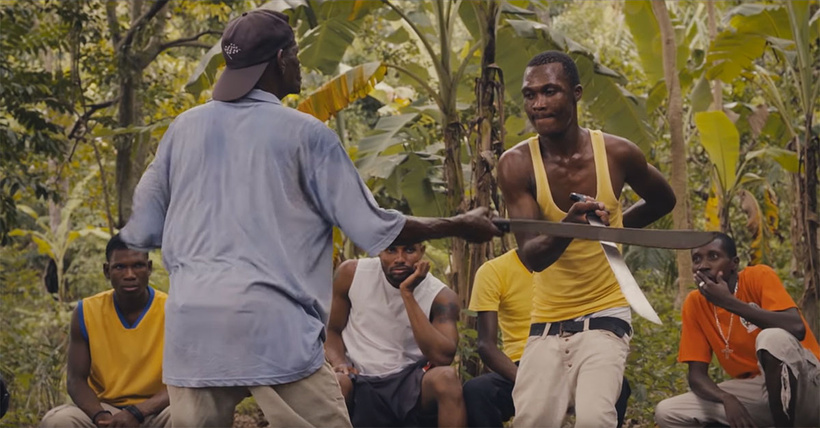
The Martial Art of Papa MacheteI first encountered Haitian Machete Fencing through a short documentary by National Geographic, featuring the late Alfred Avril—Papa Machete—a master of the Haitian art of machete combat. After I shared the film, one of his students, American historian Michael Dylan Rogers, got in touch. Michael is co-author of the recently published book Haitian Machete Fencing: The Avril Family Method. The book goes far beyond your standard martial arts manual. It offers a vivid and intimate glimpse into a living tradition rooted deeply in Haitian culture, beautifully illustrated through the lush photography of Charles Espey. For those of us engaged in historical European martial arts, it offers many thought-provoking parallels. The spiritual aspect of training is made tangible—something only vaguely hinted at in the prayers and preambles of some fechtbücher. I found it particularly striking that the method doesn’t include instructions on how to cut effectively with a machete. That skill, as the authors explain, is considered basic knowledge in Haiti—just as European fight books rarely teach fundamental cuts or footwork. One story stood out to me in particular: a student describes having to empty half a bottle of rum during a training session. When he expressed concern about becoming intoxicated, Master Avril replied that, in the event of a real fight, he would likely be drunk too. It reminded me of close-combat expert Rory Miller, who writes that he never stretches before training—because there’s no time to warm up before a surprise attack either. Instead, he makes daily physical readiness part of his lifestyle. I also applaud the authors for donating all royalties from the book to the Haitian people through their nonprofit organisation, Cultural Capital Haiti. Get the book here. As it happens, a technique developed by Cornelius and Janis at Dimicator Schola for countering strikes to the legs—attacks not covered in MS I.33 but common in modern sparring—found unexpected validation in Haitian machete practice. Cornelius and I are currently preparing our next online course, which will focus on dealing with such unconventional attacks using core concepts from the fight book. If you want to start training in this direction, we recommend our second course on the fundamental principle of Schutzen—available now at 15% off.
So, that's it for today. Take care, and keep your blade well-honed. If you enjoyed this newsletter, please recommend it to your friends. They can sign up here or on my website. Or simply forward them this email. Improve your skills with our sword-and-buckler online courses. If you wish to read more, find hundreds of related posts on my Patreon. Special thanks to all my loyal supporters on Patreon – you keep me going! And if you are not a patron yet, you are most welcome to join. If you feel like dropping a coin into my tip jar, you can do so here. Thank you for your time and your interest. Yours, Roland You are receiving this newsletter because you have signed up for it, or because you have previously expressed your interest in my work and events. If you prefer to not receive further emails, you can unsubscribe below. |
Dimicator
I’m Roland Warzecha — professional illustrator and swordsman. The name Dimicator comes from the Latin for “sword fighter.” I share cutting-edge research into historical martial arts, focusing in particular on Viking and high medieval sword-and-shield combat. My work is carried out in collaboration with museums, fellow martial artists, and scholars around the world.
Hello archaeology enthusiasts, fighters and fellow history aficionados, there is quite a lot happening behind the scenes at the moment — from ancient weapons and practical martial arts research to medieval emperors and historical films. So today, let me take you from a Late Bronze Age spearhead to an upcoming spear-and-shield course, two opportunities to train together, yesterday’s remarkable events in Magdeburg — and finally two film projects that I am very much looking forward to seeing....
Hello fellow history enthusiasts and blade aficionados, one of the great privileges of studying original weapons is that there are things an object can reveal in your hands which are remarkably difficult to recognise from photographs, measurements or typological descriptions alone. But researching an object is one thing; communicating what you have learned is another. Sometimes it takes a detailed drawing. Sometimes, video and photos would do the job — however, permission to share them with...
Hello fellow history enthusiasts and blade aficionados, The past fortnight has been wonderfully busy. From teaching at HEMA Camp 1387 in Lithuania and studying remarkable museum pieces to continuing several long-term research and reconstruction projects, there has been plenty to keep me occupied. I hope you'll enjoy the latest updates. A Week of Swords in Lithuania I have just returned from an unforgettable week in Lithuania, filled with fencing, research, museum visits, inspiring...